

 Mood · Kanchanaburi
Historical · quiet · green · striking
Kanchanaburi
Bridge over the Kwai, elephants and the darkest chapter of the Second World War.
Kanchanaburi is where the Second World War in Asia becomes tangible. The Death Railway, built by over 100,000 prisoners of war under Japanese supervision, ran here across the Kwai Noi. More than 100,000 people died during its construction. Below is everything you need to know before exploring that history, and how to combine it with the nature around it.
Country
Thailand
Region
Kanchanaburi Province, western Thailand
Currency
Thai Baht (THB)
Language
Thai (limited English)
Time zone
7 hours ahead of Amsterdam
Best time
Nov, Feb
Getting there
Bus or train from Bangkok (2-2.5 hours)
Per day
€30, €90 p.p.
Safety
Very safe
Who it suits
- History enthusiasts wanting to understand the Second World War in Asia
- Nature lovers: waterfalls, elephants and floating bungalows on the Kwai
- Travellers combining Bangkok with a two-day trip or overnight stay
- Families with children aged 10+ for the mix of nature and history
Less suited if…
- Beach-goers: Kanchanaburi has no beach; take the train to Hua Hin for that
- Anyone seeking nature alone without historical context: the two are inseparable here
 Mood · Kanchanaburi
The bridge still stands. The graves are still there. The river still flows beneath it.
Don't miss
Highlights
The things to plan your day around.
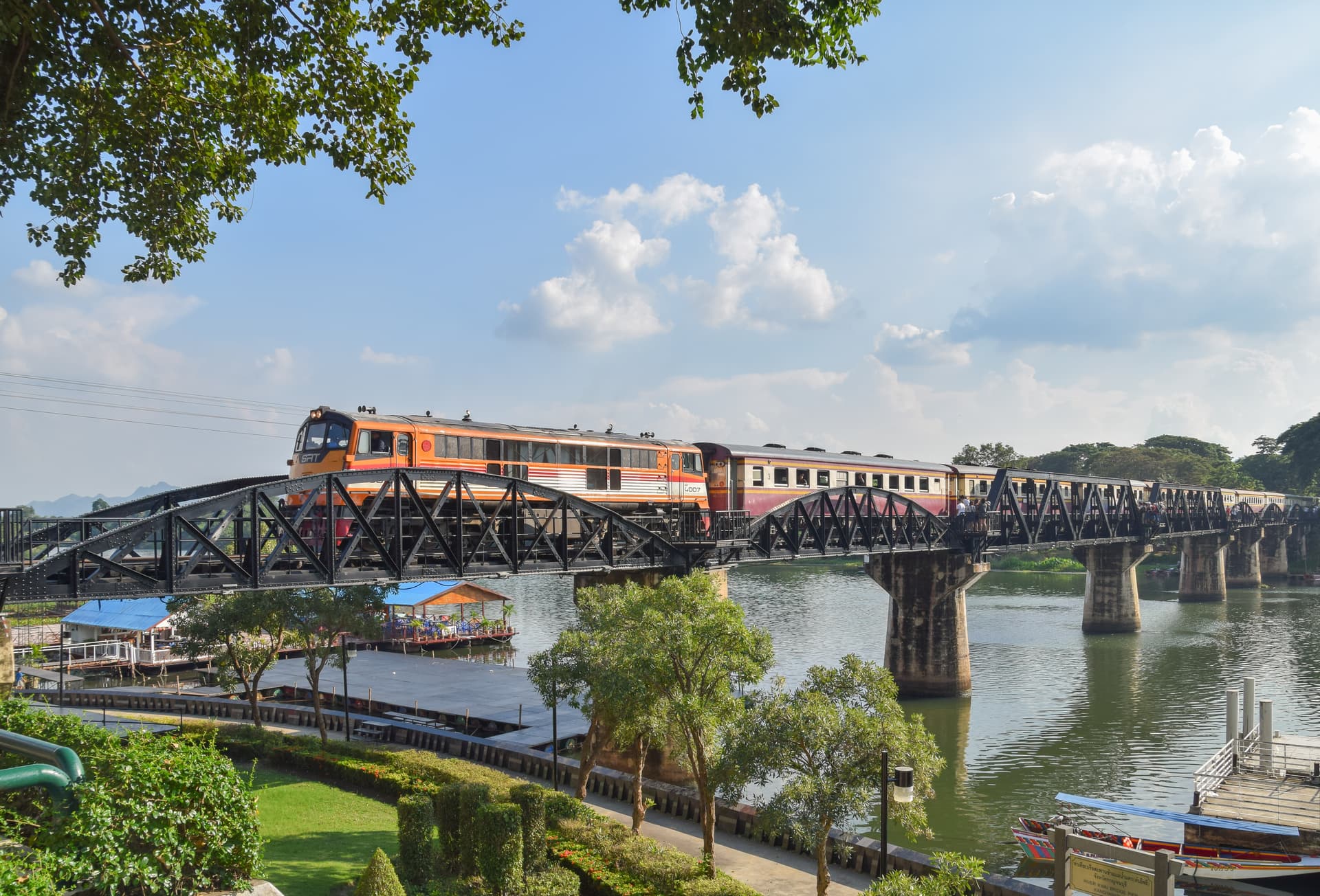 Photo: Krzysztof Golik (Wikimedia, CC BY-SA 4.0)
The Bridge over the Kwai
Symbol of the Death Railway: a walkable footbridge spanning the river
 Mood · Kanchanaburi
JEATH War Museum
Thailand's most austere and powerful war museum
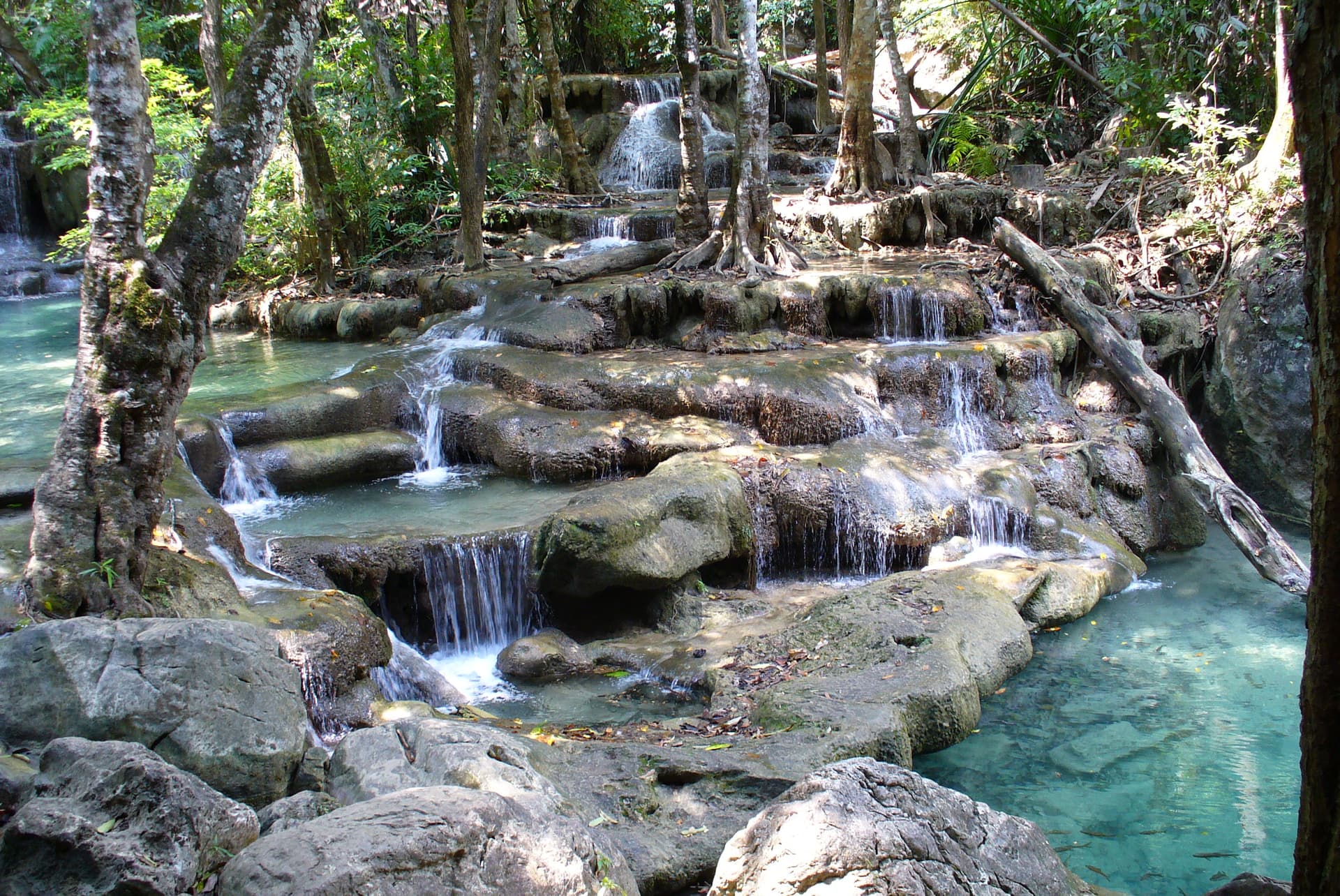 Photo: FearOfMusic (Wikimedia, CC BY-SA 3.0)
Erawan Waterfall
Seven tiers of clear limestone pools in Erawan National Park
 Mood · Kanchanaburi
Kanchanaburi War Cemetery
6,982 graves of British, Dutch and Australian prisoners of war
 Mood · Kanchanaburi
Floating Bungalow on the Kwai
A night on the water: bamboo raft, jungle all around, stars above
💡 Local tip
Take the early morning train from Thonburi Station in Bangkok (departure 7:45), arriving in Kanchanaburi at 10:15, leaving a full day for temples and museums. A more scenic ride than the bus.
 Mood · Kanchanaburi
Eat
Where to actually eat
No tourist traps.
 Mood · Kanchanaburi
Floating Restaurant on the Kwai
Dining on the water: fresh fish, Thai curries and the sound of the river
← swipe for more →


⚠️ Avoid this mistake
Don't just visit the bridge. Without the context of the war cemetery and museums, it's just a steel bridge. With that context, it's a monument. Do the museums first.
Hellfire Pass gives you the scale. The museum gives you the faces. Together they make history tangible.
See
What you really must see in Kanchanaburi
 Mood · Kanchanaburi
Hellfire Pass Museum
The toughest section of the Death Railway, an open-air museum with a walking trail
 Mood · Kanchanaburi
Travelling on the Death Railway
The same track, the same mountainside: a train ride with historical significance
 Mood · Kanchanaburi
Thailand-Burma Railway Museum
The most comprehensive museum on the Death Railway, interactive and well done
 Mood · Kanchanaburi
Kayaking on the Kwai Noi
Quiet kayak journey through the jungle: monkeys, birds and silence
↗️ Worth the detour
Hellfire Pass (80 km, car required) is less visited than the bridge but offers a deeper and more honest historical experience. Walking the cut rock path makes the scale of the work palpable.
Discover
Everything on the map
Filter by what you're after.
 Mood · Kanchanaburi
After a day at the cemetery, you'll eat the best meal of your life at the floating restaurant.
Out and about
Best day trips
Out of the city within an hour.
 Mood · Erawan Waterfalls
Erawan Waterfalls
~1.5 hours by songtheaw~65 km · Seven tiers of limestone pools
The Erawan Waterfalls are seven tiers of limestone pools with clear water. The lower two are easily reached; the upper two require a two-hour climb. The pools are swimmable, so bring a swimsuit. Go on a weekday to avoid the weekend crowds.
View day trips (opens in a new tab) Mood · Hellfire Pass
Hellfire Pass
~1.5 hours by car~80 km · The harshest section of the Death Railway
Hellfire Pass is the section of the Death Railway hacked through a rock massif using hands and tools, at night, by torchlight. An Australian museum and walking trail bring its scale and suffering to life. There's no public transport: a car or private transfer is necessary.
View day trips (opens in a new tab) Mood · Bangkok
Bangkok
~2-2.5 hours by train~130 km · The Thai capital as counterpoint
Kanchanaburi is just two hours from Bangkok, meaning you can combine the historic town with a day in the capital. Bangkok serves as your arrival or departure point. If Kanchanaburi is your base, a day in Bangkok makes a perfect finale, for the food, the markets and the Grand Palace.
View day trips (opens in a new tab)Practical
Everything you need to know
Weather & best time
Kanchanaburi has a pleasant dry season (November, February) and a hot dry season (March, May). The rainy season (June, October) makes the Erawan Waterfalls murkier but the jungle greener.
Jan
☀️
16-33°
Apr
🌤️
24-38°
Jul
🌧️
24-33°
Oct
🌦️
22-33°
What does a day cost?
Budget
€25 /dag
Island guesthouse, night market meals, bicycle for the bridge, free cemetery visit.
Mid-range
€70 /dag
Riverside hotel, floating restaurant, Erawan Waterfalls day trip, Thailand-Burma Railway Museum.
Luxury
€150+ /dag
Floating bungalow on the Kwai Noi, private guide for Hellfire Pass, elephant sanctuary, boat trip.
Good to know
Visa
Visa on arrival (NL: 30 days free)
Payment
Cash (THB); ATM in centre
Plug
Type A/B/C · 220V
Transport
Tuk-tuk, bicycle or scooter
Tap water
Do not drink
History
WWII Death Railway: respectful behaviour
 Mood · Kanchanaburi
The train ride to Nam Tok is one of Asia's most remarkable journeys. Book a window seat.
Sleep
Pick your neighbourhood, not the stars
By travel style: book through our partners.

Riverside Hotels along the Kwai
River views: the finest address in Kanchanaburi

Floating Bungalows on the Kwai
Sleep on the water in the jungle: the most distinctive stay in the area

Budget Guesthouses Kanchanaburi
Affordable guesthouses within walking distance of the bridge and museums
Before you go
Sorted before you set off
Worth booking ahead.
Questions
Frequently asked questions
Is Kanchanaburi a day trip or an overnight from Bangkok?
Both work well. As a day trip by train (2 hours each way) you can easily cover the bridge, the war cemetery and the JEATH museum in one day. But staying overnight adds a lot: the floating bungalows on the Kwai Noi, the train ride to Nam Tok and a day trip to Erawan or Hellfire Pass are each worth half a day. Two nights is ideal.
How do I get from Bangkok to Kanchanaburi?
By train from Thonburi station (not Hua Lamphong), 2.5 hours, very cheap and atmospheric. By bus from the Southern Bus Terminal (2 hours, 100 THB). By minivan from Khao San Road (private arrangement, 2 hours). The train is the most scenic route but departs early (7:45 and 13:45).
Should I see the bridge, or are the museums more important?
The bridge is an icon, but the museums provide the context. My recommendation: start at the war cemetery (emotionally heavy, small and austere), then visit the Thailand-Burma Railway Museum (extensive, well done), then walk to the bridge. This way you'll understand the bridge differently than if you visit it on its own.
Are the Erawan Waterfalls accessible all year?
The park is open year-round, but the waterfalls look their best and are easiest to walk in the dry season (November, April). In the rainy season (May, October) the water can turn very brown from mud and the higher levels are sometimes closed. The park gets very busy on Sundays, so go on a weekday.
Is there anything special for children in Kanchanaburi?
The Erawan Waterfalls are wonderful for children: swimming in the pools, fish nibbling at your feet. The floating bungalows on the river are an adventure for children over 6. The historical museums are recommended for children over 10, as the subject matter is heavy. An elephant sanctuary is also an option (avoid riding).
Wayloha editorial · Editorial
Updated June 2026
Commonwealth War Graves Commission · Thailand-Burma Railway Museum · Australian War Memorial · JEATH War Museum · Erawan National Park (DNP Thailand) · TAT Kanchanaburi · Lonely Planet Thailand 2024
Kanchanaburi awaits
The bridge still stands. The graves are still there. The river still flows beneath it. Kanchanaburi is the place where the Second World War becomes tangible in Asia.
Plan your Kanchanaburi tripMore in Thailand
More cities in Thailand

Bangkok
Bangkok travel guide: the best temples, street food spots, markets and day trips. Checked by the Wayloha editorial team. Includes seasonal tips and budget advice.
Read the guide →
Ayutthaya
Ayutthaya travel guide: the best temples, cycling tips and how to experience the historical park at sunrise. Checked by the Wayloha editorial team.
Read the guide →
Sukhothai
Sukhothai travel guide: the Historical Park, Wat Mahathat, Wat Sri Chum, Si Satchanalai and Loy Krathong. Checked by the Wayloha editorial team.
Read the guide →
Khao Sok
Khao Sok travel guide: floating bungalows on Cheow Lan Lake, jungle trekking and gibbons at sunrise. Checked by the Wayloha editorial team.
Read the guide →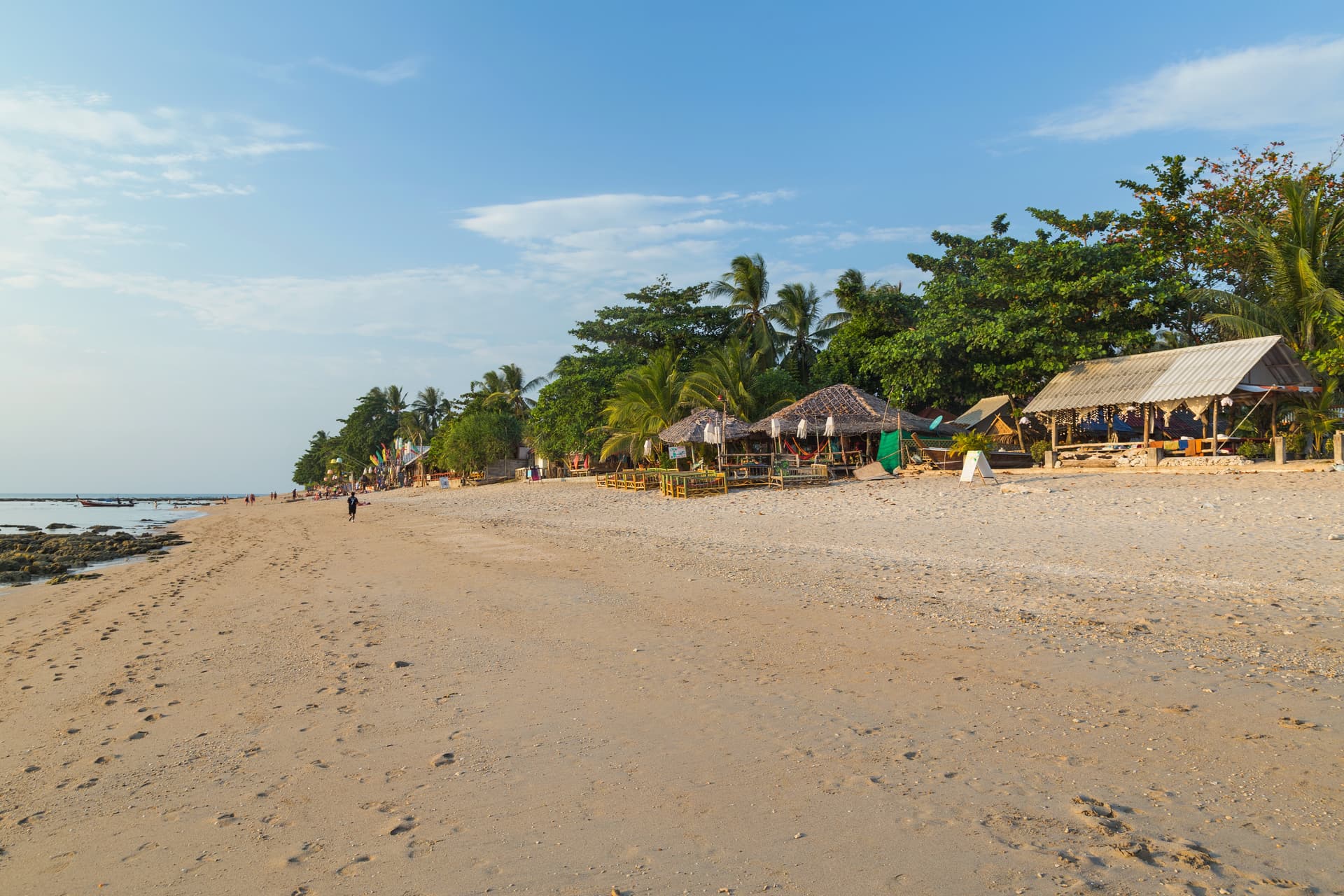
Koh Lanta
Koh Lanta travel guide: long beaches, mangroves, diving at Koh Haa and authentic Lanta Old Town. Checked by the Wayloha editorial team.
Read the guide →
Koh Samui
Koh Samui travel guide: Ang Thong Marine Park, Fisherman's Village in Bophut, Chaweng Beach and day trips to Koh Tao. Tips for the season, transport and the island's best beaches.
Read the guide →Part of Thailand
New to Thailand?
Read our complete Thailand travel guide: regions, best time to go and practical tips before you plan your trip.