

 Mood · Kobe
Cosmopolitan · refined · relaxed · east-and-west
Kobe
World-famous wagyu, European villas and a harbour: checked at source.
Kobe is not a city that overwhelms you; it's one that seduces you. Below you see at a glance how Kobe fits together: when to go, what it costs, how to get around, and which day trips are worth it. The addresses to eat, do and see follow further down. Tip ahead: do it on an empty stomach, plan your day around the Kitano hillside and the harbour, and leave room for chance: a back street with a European villa, a stall in Chinatown, a sake tasting in Nada. There, where east and west have met for 150 years, sits the soul of Kobe.
Country
Japan
Region
Kansai, Honshu (Hyogo prefecture)
Currency
Japanese yen (¥)
Language
Japanese (dialect: Kansai-ben)
Time zone
7-8 hours ahead of Amsterdam
Best time
Autumn (Oct, Nov) · Spring (Mar, Apr)
Airport
KIX 60 min · ITM 40-45 min
Per day
€90, €180 p.p.
Safety
Exceptionally safe
Who it suits
- For food lovers: this is where Kobe beef was born, the softest, most richly marbled wagyu in the world. Eat it from the teppanyaki plate where the chef prepares it before your eyes, and discover besides Chinatown buns, miso-gyoza and the sake of Nada.
- For culture lovers: Kobe opened in 1868 as one of the first harbours for foreign trade and has remained a blend ever since, with Victorian and Moorish merchant villas on the Kitano hillside, a centuries-old Chinese community, and the most European street in Japan.
- For couples and luxury travellers: compact, stylish and relaxed, with a beautiful harbour to walk along, refined restaurants and a wine and sake culture you won't find anywhere else in Japan. An evening here feels like a short city trip to Europe and Asia at once.
- For day trippers from Osaka or Kyoto: Kobe is half an hour away by train. Half a day is enough for the harbour and a good piece of meat; a full day, and you'll fall in love. Design and architecture lovers also find plenty to their taste here.
Less suited if…
- For those seeking temples and classical Japan: that's Kyoto, three quarters of an hour away. Kobe is about harbour, trade and the exchange between east and west; the finest spots are villas and quays, not sanctuaries.
- For those wanting to travel on a shoestring: Kobe is more refined and costly than nearby Osaka. A proper piece of Kobe beef costs what it's worth, and the city breathes quality rather than bargains.
- For those wanting lots of grand sights in one go: Kobe is small and revolves around atmosphere, food and walking, not a long tick-box list. Better to combine it with Osaka, Kyoto or Himeji for a fuller programme.
 Mood · Kobe
Osaka eats, Kyoto prays, and Kobe lives between mountains and sea, with style.
To do
Bookable experiences
Arima Onsen, Nunobiki Herb Garden, a Nada brewery tour and a harbour cruise: bookable in advance
 Mood · Kobe
Soak for a week in Arima Onsen, Japan's oldest spa town
Gold and silver baths in the mountains above Kobe
 Mood · Kobe
Glide up to the Nunobiki herb garden
A fragrant hillside garden with harbour views
 Mood · Kobe
Taste the sake of Nada
The country's finest brewing district
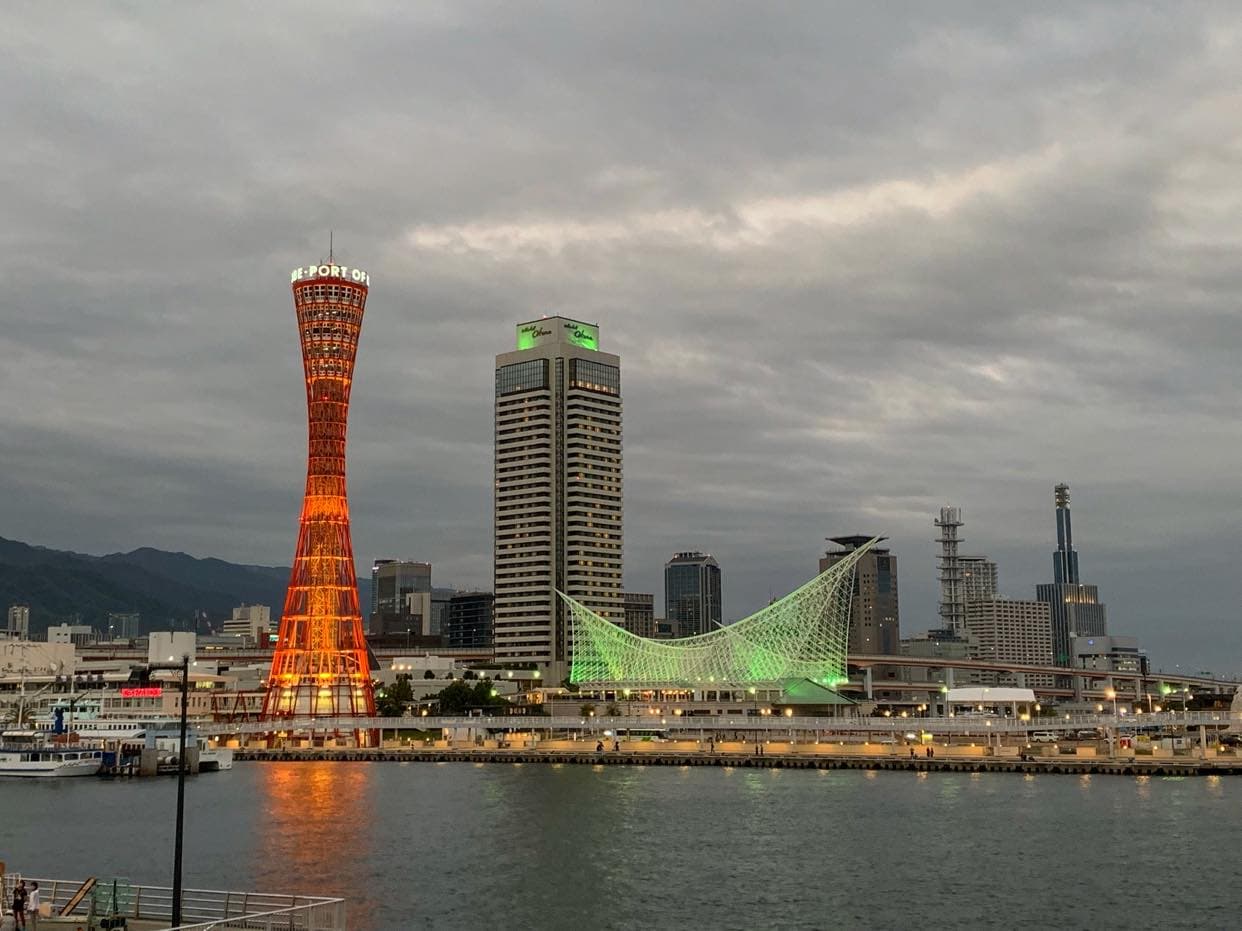 Photo: 劉珮琦 (Wikimedia, CC BY-SA 4.0)
Sail into the bay at sunset
Kobe from the water, skyline aglow
💡 Local tip
Get an ICOCA card straight away and load it onto your phone, but Kobe is so compact you can do Kitano, Chinatown and the harbour on foot. The free City Loop bus links the icons together if your legs get tired. Want a Kobe beef classic? Book days ahead and go for a lunch set: just as good, and far more reasonably priced than dinner.
 Mood · Kobe
Eat
Where to actually eat
No tourist traps.
 Mood · Kobe
Taste Kobe beef at Steak Aoyama
A teppanyaki institution in Kitano since 1963
 Mood · Kobe
Eat A5-wagyu at Mouriya
Over a century of Kobe beef on the Kitanozaka
 Mood · Kobe
Join the queue for Rōshōki's butaman
Chinatown's most famous pork buns
 Mood · Kobe
Lunch in an old church at Freundlieb
German bakery-café since 1924, close to Kitano
 Mood · Kobe
Dip Kobe gyoza in miso at Ganso Gyōzaen
The house that invented miso-gyoza, since 1951
⚠️ Avoid this mistake
Don't confuse Kobe with a temple town: anyone coming here for classical Japan will walk away disappointed. Kobe is about harbour, commerce and the meeting of East and West; the beauty lies in villas, quays and food, not in shrines. And don't underestimate the price of genuine Kobe beef: a bargain 'Kobe beef' plate rarely is. Look for certification, or deliberately choose the budget version, bata-yaki.
Kobe beef was born here: the benchmark for all wagyu in the world.
See
Kobe's icons: from Kitano to the harbour
← swipe for more →


↗️ Worth the detour
Venture off the beaten path: the European boutiques of Tor Road (Japan's most Western street), the quiet backstreets of Kitano in golden hour, the surprisingly good Kobe Winery in the hills, and the cable car and night views from Mount Rokkō or Maya, one of Japan's finest skylines. Those who look beyond the harbour are rewarded.
Discover
Everything on the map
Filter by what you're after.
 Mood · Kobe
On Kitano's hill, Japan suddenly feels like a European seaside town.
Out and about
Best day trips
Out of the city within an hour.
 Mood · Osaka
Osaka
~30 min by train from Sannomiya30 km · Japan's kitchen, neon and street food
Kobe's boisterous big neighbour is half an hour away by train, and the contrast is delightful. Where Kobe is refined and relaxed, Osaka lets loose: neon from Dōtonbori reflects in the canal, takoyaki sizzles on every corner, and Osakans strike up conversations faster than anywhere else in Japan. It's the country's kitchen and its friendliest city. Come for an evening of eating and wandering, then head straight back to quiet Kobe. Together they form the two faces of the Kansai region.
View day trips (opens in a new tab) Mood · Himeji
Himeji
~15 min by shinkansen from Shin-Kobe (or ~40 min by JR express train)55 km · Japan's most beautiful castle: UNESCO world heritage
A quarter of an hour by shinkansen west of Kobe (from Shin-Kobe) stands Japan's most spectacular castle: Himeji-jō, nicknamed the 'white heron' for its elegant, snow-white façade. It is the best-preserved feudal castle in the country: never destroyed, never rebuilt. It's on UNESCO's world heritage list. You wander through the defensive maze upwards towards the towers and gaze out over the city, and in spring the complex drowns in cherry blossom. Essential for anyone interested in history or architecture, and easy to combine with Kobe on the same trip.
View day trips (opens in a new tab) Mood · Kyoto
Kyoto
~55 min by train75 km · Temples, tea houses and classical Japan
Where Kobe looks forward to the sea and the world, Kyoto looks back a thousand years, and that contrast makes it a rich day trip. Just under an hour by train takes you from the European villas of Kitano to a thousand temples, moss gardens and geisha alleyways. Walk the red torii of Fushimi Inari at dawn, wander through the bamboo grove of Arashiyama, and taste the ancient soul of Japan. Together with Kobe and Osaka, Kyoto completes the Kansai region: commerce, cuisine and culture, all three a train ride apart.
View day trips (opens in a new tab)Practical
Everything you need to know
Weather & best time
Four distinct seasons: mild and blooming in spring, humid and wet in summer (rainy season in June, heat in July, August, with evening harbour festivals), clear and coloured in autumn (the loveliest), and cold but mild and quiet in winter, with the enchanting Kobe Luminarie beginning in early December.
Jan
✨
3-9°
Apr
🌸
11-20°
Jul
☀️
25-33°
Nov
🍁
9-18°
What does a day cost?
Budget
€90 /dag
Hostel bed or guesthouse near Sannomiya, street food in Chinatown and a butaman or helping of miso-gyoza, free icons like Kitano and the harbour, all with the ICOCA card.
Mid-range
€160 /dag
Nice hotel near Sannomiya, one good meal a day (Kobe beef lunch or a European café in Kitano), a harbour cruise or the herb garden, and a day trip to Himeji or Arima.
Luxury
€380+ /dag
A design hotel or ryokan in Arima Onsen, an A5 Kobe beef dinner at a classic like Mouriya, a private guide and first-class trains for day trips.
Good to know
Visa
Not required (NL, ≤90 days)
Payment
Cards work, but cash is often still needed
Plug
Type A · 100V
Getting around
Walking, local trains, ICOCA card
Tap water
Safe to drink
Tipping
Not customary
 Mood · Kobe
Half an hour from Osaka, and a world of refinement away.
Sleep
Pick your neighbourhood, not the stars
By travel style: book through our partners.

Hotels in Kobe
Compare hotels around Sannomiya and Motomachi or with harbour views at Harborland: budget to luxury, close to food and transport.

Local stays
Your own apartment or traditional room in an authentic Kobe neighbourhood, often larger and better value than a hotel.

Experiences & day trips
Kobe beef dinners, an Arima Onsen outing, Nunobiki's herb garden, a harbour cruise and day trips to Himeji, Osaka and Kyoto.
Before you go
Sorted before you set off
Worth booking ahead.
Questions
Frequently asked questions
Is Kobe worth a visit?
Absolutely. Kobe is Japan's most cosmopolitan city and a relief if you want to break from classical Japan for a bit. Here Kobe beef was born, the benchmark for all wagyu; on Kitano's hill stand European merchant villas; below lies a vibrant Chinatown; and at the quay you gaze over a beautiful harbour. It's compact, stylish and easy to walk, and it blends Japanese precision with European refinement in a way you won't find anywhere else. For half a day it's a perfect excursion from Osaka or Kyoto; for a full day you'll fall in love with it. Feel free to combine it with the spectacular Himeji Castle, half an hour away.
Can you do Kobe as a day trip from Osaka?
Very much so: Kobe is about 30 minutes by train from Osaka (Sannomiya is the central station) and around 55 minutes from Kyoto. Many travellers do it as a day trip: a morning over Kitano's hill, lunch on Kobe beef or in Chinatown, and an afternoon along the harbour at Meriken Park. If you want to get more out of it, such as Arima Onsen in the mountains, Nunobiki's herb garden, a sake brewery in Nada or a harbour cruise at sunset, an overnight stay is worthwhile. With an ICOCA card you tap in and out as you go; you'll explore the city itself mostly on foot and with a few short rides.
Is Kobe beef worth the price?
If you love beef and want to do it properly once: yes. Kobe beef is the original and the benchmark: wagyu from Tajima cattle in the Hyogo region, with marbling and tenderness that melts on your tongue. It's expensive because it's scarce and strictly certified, but the experience, with the chef preparing it on the teppanyaki plate before your eyes, bite by bite, is a memory in itself. Order it at minimum as teppanyaki or shabu-shabu, and reckon on around 100 grammes per person to truly taste it. A lunch set is often much friendlier priced than dinner if you want to try it without the main expense. And for the budget-conscious: look for bata-yaki, Kobe beef pieces fried in butter at the market.
What exactly is Kitano-chō?
Kitano-chō is the hillside neighbourhood where foreign merchants settled after Kobe opened its port to international trade in 1868. They built their homes in Western style: the ijinkan, literally 'foreign houses', with Victorian bays, a Moorish pavilion, a Dutch and an English villa, and views over the harbour. Some are now open as small museums; the rest you simply enjoy from the street. It feels more like a European hill town than Japan, and that contrast is precisely the charm. Go at the end of the afternoon when the crowds fade and golden light falls across the façades.
Is Arima Onsen worth the journey?
If you love hot springs and have the time: absolutely. Arima is one of Japan's oldest and most famous hot spring resorts, with over a thousand years of history, and it's surprisingly close, just half an hour through the mountains from Kobe on the direct train (the scenic cable car route over Rokkō takes just over an hour). The town is small and atmospheric, with narrow streets lined with wooden houses, and it revolves around two types of water: the iron-rich, rust-brown kinsen ('gold') and the clear ginsen ('silver'). You can bathe for a couple of hours in a public bathhouse or stay a night in a ryokan for the full experience. For a relaxed half day away from the city, it's one of the finest excursions in the Kansai region.
When is the best time to visit Kobe?
October and November are loveliest: mild weather, clear skies and autumn colours in gardens like Sōrakuen. Spring (late March, April) is a beautiful alternative, with cherry blossom in parks like Oji Zoo and the gardens. Summer (July, August) is muggy and over 33°C, with a wet rainy season in June, though summer evenings do bring harbour festivals. Winter is mild and quietest, with one highlight: the Kobe Luminarie, an enchanting light festival in early December in memory of the 1995 earthquake victims, and one of Japan's finest winter events.
How do you get to Kobe and how do you get around?
Most international travellers land at Kansai (KIX) and travel through to Kobe in roughly 60 minutes (bus, or train via Osaka); the Kobe Limousine Bus runs direct from KIX to Sannomiya station in ~65 minutes (about ¥2,200). The smaller Itami (ITM) is some 40-45 minutes away. The central hub is Sannomiya station, where the JR, Hankyu and Hanshin lines converge; from Osaka you're there in ±30 minutes, from Kyoto in ±55. Within the city itself, you'll get the farthest on foot, as Kitano, Chinatown and the harbour are within walking distance of each other, supplemented by a few short train rides and the handy City Loop bus. Get an ICOCA card straight away (or add it to your phone) and tap in and out.
Wayloha editorial · Travel sources curation
Last reviewed: June 2026 (first publication); all addresses, times and opening status verified at source.
Compiled and verified from travel publications and official sources (Tripadvisor, the websites of Mouriya and Freundlieb, the official VISIT KOBE / feel-kobe.jp guide, Hanshin's Nada brewery pages, foodinjapan.org on Kobe miso-gyoza, and the GetYourGuide kobe-l32593 catalogue). All five restaurants and attractions have been verified as existing and operational in 2026; opening times are deliberately hedged ('check ahead') where no single canonical source sufficed.
Final word: the editors
We keep Kobe up to date as things change: opening hours, prices and seasonal peaks lead the way.
Plan your Kobe tripMore in Japan
More cities in Japan

Osaka
City break Osaka: the best street food, the neon of Dōtonbori, the castle and where you really eat well, fact-checked at source. Plus day trips, weather and budget.
Read the guide →
Kyoto
Kyoto city trip: the most beautiful temples, the Fushimi Inari torii gates, Gion, and where to eat well, fact-checked at the source. Plus day trips, weather, and budget.
Read the guide →
Nara
City break Nara: the sacred deer, the Great Buddha of Tōdai-ji, the lantern paths of Kasuga and where to eat really well, verified at source.
Read the guide →
Hiroshima
City trip Hiroshima: the Peace Park, the island Miyajima with its floating torii, the original okonomiyaki and fresh oysters, verified at source.
Read the guide →
Kanazawa
City trip Kanazawa: the Kenroku-en garden, the samurai and geisha neighbourhoods, the Omicho market and where to really eat well, source-verified. Plus day trips.
Read the guide →
Tokyo
Tokyo city trip: the best places to eat, the neon of Shibuya and the quiet shrines, checked at the source. Plus day trips, weather and budget.
Read the guide →Part of Japan
New to Japan?
Read our complete Japan travel guide: regions, best time to go and practical tips before you plan your trip.