

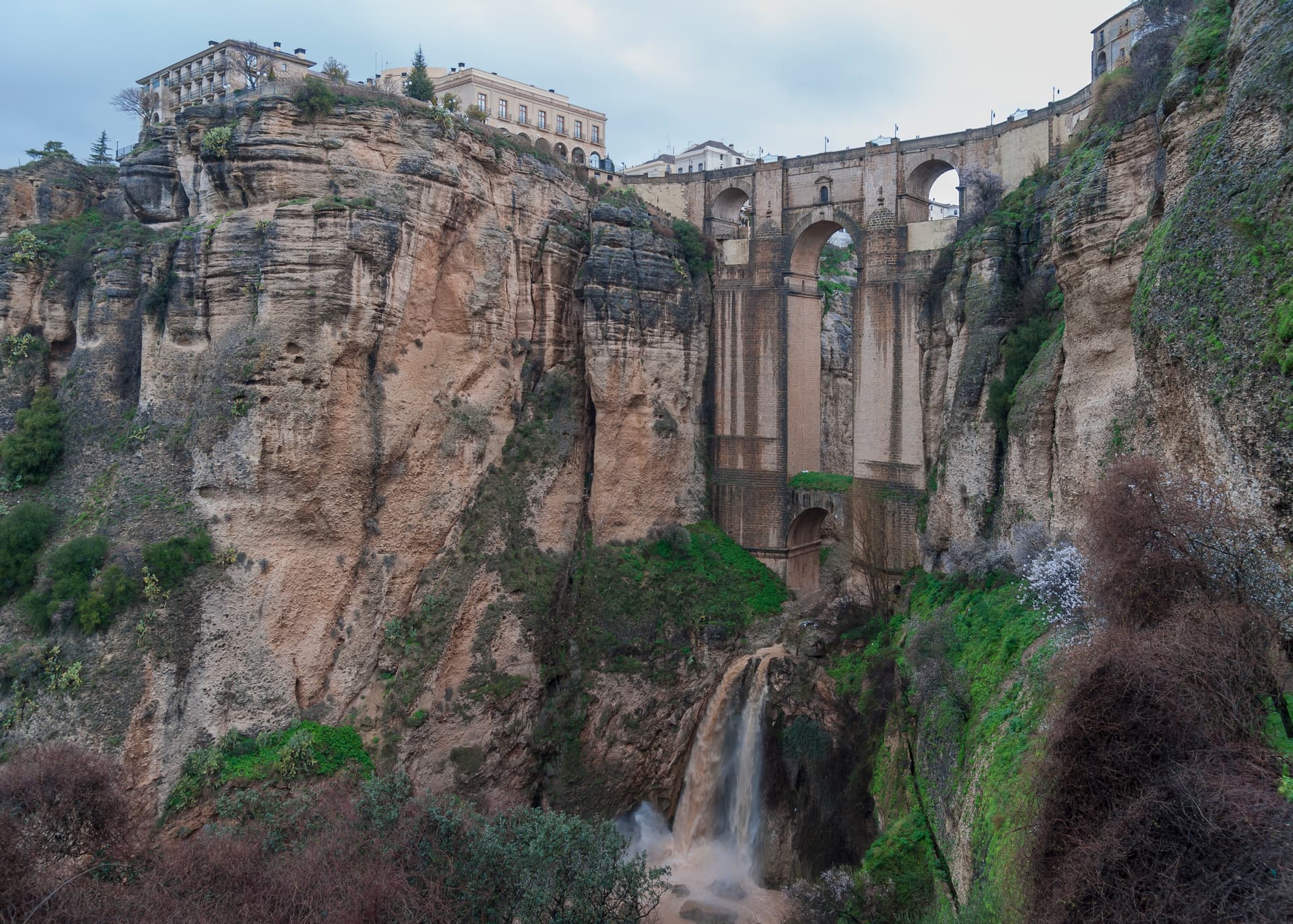
 Photo: CEphoto, Uwe Aranas (Wikimedia, CC BY-SA 3.0)
Dramatic, serene, historic: Andalusia at its most irreplaceable
Ronda
El Tajo gorge, the Puente Nuevo, the baños árabes and Bardal's Michelin cuisine.
Some cities make you most aware of the earth: the fact that the landscape, the soil, and the elevation are the reasons the city stands here and nowhere else. Ronda is one such city. The El Tajo gorge is not the backdrop of Ronda; it is the reason for its existence. Two rock cliffs, a gorge 120 metres deep, and a bridge that took 34 years to connect them. The Puente Nuevo (1793, 98 metres high) is the most photographed object in Andalusia, but it is the walk along the edge of the gorge via the Paseo de los Ingleses that makes the true scale clear: you are standing beside something that exceeds human proportions. La Ciudad, the Moorish core on the southern side of the gorge, features baños árabes that are among the best preserved in Spain, a thirteenth-century city gate (Puerta de Almocábar) that remains unchanged, and streets that the reconquista of 1485 barely altered. The Plaza de Toros (1785) is considered the mother of modern bullrings in Spain: the width of the ruedo and the height of the barreras were established here. And Restaurante Bardal, with Benito Gómez holding two Michelin stars, brings the products of the Serranía de Ronda into a culinary language that has no equal in the mountains of Málaga. Plan the whole day. Ronda demands time.
Country
Spain
Region
Andalusia (Málaga)
Currency
Euro (€)
Language
Spanish · little English in small bars
Time zone
Same as Amsterdam
Best time
Mar, May · Sep, Nov
Airport
AGP Málaga (1h 15m car · 1h 45m bus)
Per day
€50, €350+ p.p.
Safety
Safe · early = less day-trip crowds
Who it suits
- For those wanting to see the most dramatic urban landscape in Andalusia: Ronda literally sits on a cliff. The city is divided in two by the El Tajo gorge, which is 120 metres deep and 300 metres wide. The Puente Nuevo (1793) connects the two sides. There is little like it in Andalusia.
- For those on a day trip from Málaga (1h 45m by bus) or driving as a stopover from the Costa del Sol to Seville: Ronda is one of Andalusia's best day trip destinations. For a full day trip experience: take an early bus (approx. 7:00 am on weekdays, later on weekends, ~1h 45m), go straight to the gorge, and walk through La Ciudad. You will be back in time for dinner.
- For those wanting to experience the Spanish gastronomic renaissance: Restaurante Bardal (Benito Gómez, two Michelin stars) has put Ronda on the culinary map of Europe. The cuisine is hyper-local, using products from the Serranía de Ronda (goat, wild herbs, local olive oil) in an experimental yet accessible style. Reserve weeks in advance for the evening menu.
Less suited if…
- For those seeking a full day of city sightseeing: Ronda is small (33,000 inhabitants) and the main attractions can be seen in one and a half to two hours. The best way to use Ronda is: arrive early, walk through the Puente Nuevo and La Ciudad, have lunch, and use the afternoon for the terraces overlooking the gorge. Two nights is pleasant but not necessary.
- For those whose main goal is nature: the Serranía de Ronda (the mountain area around the city) is beautiful but requires a car. If you do not have your own transport, nature remains within sight but out of reach.
- For those visiting in August: Ronda is very busy in summer (due to day excursions from the Costa del Sol) and very hot (32-36°C). Visit in spring or autumn for the best balance of temperature and visitor density.
 Photo: Tesla Delacroix (Wikimedia, CC BY-SA 4.0)
There are places you remember as 'beautiful'. You remember Ronda as 'impossible'.
Don't miss
Highlights
The things to plan your day around.
 Photo: dokaspar (Wikimedia, CC BY-SA 3.0)
The bridge over the gorge: the reason for Ronda
Puente Nuevo + El Tajo gorge: museum in the bridge, free views
 Photo: Rufus46 (Wikimedia, CC BY-SA 3.0)
The oldest bullring and the museum
Plaza de Toros de Ronda (1785) + Museo Taurino · €6.50
 Mood · Ronda
The best preserved Arabic bath ruins
Baños Árabes: thirteenth-century hammam · €4.50
 Mood · Ronda
The Moorish palace with Ronda's museums
Palacio de Mondragón: fourteenth century · Ronda's best garden · €3
💡 Be at the Puente Nuevo before 9:30
The day trip buses from the Costa del Sol arrive between 10:00 and 11:00. Before 9:30, you will have the bridge almost to yourself and the morning light hits the gorge ideally from the west. After that, it is busy until 16:30.
 Photo: Julia Kostecka (Wikimedia, CC BY 2.0)
Eat
Where to actually eat
No tourist traps.
 Mood · Ronda
Bardal: Ronda's two-star cuisine
Restaurante Bardal: Benito Gómez · Serranía products in an experimental style
← swipe for more →


💡 Jardines de Cuenca: the quiet alternative to Plaza España
The hanging gardens on the La Ciudad side offer a quieter panorama over the gorge than the always-busy Plaza España. Most visitors walk past without going in. Free, always open.
The Puente Nuevo is 98 metres high. That measurement only changes you when you are standing beside it.
See
Must-sees in Ronda
← swipe for more →


⚠️ Avoid Ronda in July and August if you hate crowds
In summer, hotels and tour operators from the Costa del Sol send hundreds of visitors daily to the Puente Nuevo. Temperatures rise to 36°C. Visit in spring or autumn for the best combination of peace and light.
Discover
Everything on the map
Filter by what you're after.
 Photo: Michel wal (Wikimedia, CC BY-SA 3.0)
La Ciudad has preserved the Moorish city walls that the rest of Andalusia tore down.
Out and about
Best day trips
Out of the city within an hour.
 Photo: CEphoto, Uwe Aranas (Wikimedia, CC BY-SA 3.0)
Grazalema
35 min by car via A-37227 km northwest · Nature + hiking trails Sierra de Grazalema · authentic mountain village · merino wool
Grazalema (27 km, 35 min by car via A-372) is the most famous mountain village in the Sierra de Grazalema: a small, white village at an altitude of 823 metres with a church on the central square, terraces, and hiking trails leading into the Parque Natural de la Sierra de Grazalema. The park features vulture colonies (vultures on the rock faces), karst formations, and unique flora due to having the highest rainfall in Spain. Grazalema is also known for its merino wool blankets and mantles. The village itself can be walked in two hours; the hiking routes in the park are a full-day programme. No car = inaccessible from Ronda.
View day trips (opens in a new tab) Photo: Slowrider (Wikimedia, Attribution)
Zahara de la Sierra
~40 min by car via A-374/A-384~35 km north · Moorish castle above the reservoir · pueblo blanco · quiet in the low season
Zahara de la Sierra (~35 km, ~40 min by car via A-374/A-384) has one of the most photogenic positions of the Andalusian mountain villages: a Moorish castle on a narrow rocky outcrop directly above the Embalse de Zahara-El Gastor, a deep blue reservoir that fills the mountain valleys. The village (1,400 inhabitants) has a wide central square, a handful of good tapas bars, and a walking path to the castle (free, 15 min climb). Ask locals if swimming is permitted, as rules for the reservoir change by season. It is almost always quiet on weekday mornings. Combine with Grazalema (15 km further) for a full drive through the Sierra.
View day trips (opens in a new tab) Photo: Tomas Fano (Wikimedia, CC BY-SA 2.0)
Olvera
~37 min by car~33 km northeast · Moorish castle + museum · starting point Via Verde de la Sierra (cycle path) · olive oil region
Olvera (~33 km, ~37 min by car) is the definitive finale of the Ruta de los Pueblos Blancos: a village of 8,500 inhabitants crowned by a Moorish castle (twelfth century, €2) and a neoclassical church on the ridge, with panoramas over the olive groves. It is also the starting point of the Via Verde de la Sierra: a converted 36 km railway line (now a cycle path) that runs through the sierra via tunnels and viaducts, making it one of the most popular cycle paths in Andalusia. Rent a bike in Olvera and ride back by bike (one-way path towards Puerto Serrano). A car is mandatory from Ronda.
View day trips (opens in a new tab)Practical
Everything you need to know
Weather & best time
Ronda is located at an altitude of 739 metres in the Serranía de Ronda, making it considerably cooler than the Costa del Sol (5-8°C lower in summer). Spring (March, May) and early autumn (September, October) are the best periods: pleasantly warm (18-22°C), no extreme heat, and the white city in its best light. July and August are hot (32-36°C) and busy: day trip buses from the Costa del Sol fill the Puente Nuevo until 16:00. Winter is quiet and mild (5-14°C), but some small restaurants have limited opening hours.
Jan
☁️
5-14°
Apr
🌤️
11-21°
Jul
☀️
18-36°
Oct
🌤️
13-22°
What does a day cost?
Budget
€50, €70 /dag
Pension or hostel in the centre (€25-45/night), tapas at Casa María or a local bar (€8-15/lunch), walking the Puente Nuevo for free, the museum in the bridge €2, Palacio Mondragón €3, Baños Árabes €4.50. Eat rabo de toro at Pedro Romero for €14-18/main course. Bus from Málaga return: ~€24.
Mid-range
€120, €160 /dag
Hotel in El Mercadillo (€60-90/night), Plaza de Toros museum €6.50, Baños Árabes €4.50, lunch on the Parador terrace (~€35 p.p.), Casa del Rey Moro La Mina €10, evening wine at Bodega Los Siete Caminos. Day trip by car to Grazalema or Zahara.
Luxury
€200, €350+ /dag
Parador de Ronda (5 stars, Plaza España, on the edge of the gorge, €150-250/night), private guide for La Ciudad and the Puente Nuevo, evening menu at Restaurante Bardal (two Michelin stars, from ~€170 p.p. excl. wine). Day trip by private car to the Serranía mountain villages.
Good to know
Visa
Not required (EU)
Payment
Small bars: cash is handy
Plug
Type C/F · 230V
Transport
On foot in the centre · car for the surroundings
Tap water
Safe
Tip
5-10%, not mandatory
 Photo: Daniel GB (Wikimedia, CC BY 2.0)
Bardal's tasting menu is Ronda on a plate: the Serranía as flavour, not as decor.
Sleep
Pick your neighbourhood, not the stars
By travel style: book through our partners.

Hotels in Ronda
From the Parador on the edge of the gorge to boutique hotels in La Ciudad.

Local stays
An apartment in La Ciudad or a whitewashed house with a garden and views over the Serranía.

Tours & tickets Ronda
Tours through the Puente Nuevo, La Ciudad and the Baños Árabes.
Before you go
Sorted before you set off
Worth booking ahead.
Questions
Frequently asked questions
How do I get from Málaga to Ronda?
By bus (Avanza/Los Amarillos, ~1h 45m, ~€13 one way) is the most common and affordable option. There is no direct high-speed train; regional trains to Ronda via Bobadilla are slower than the bus. By car, Ronda is reachable in 1h 15m via the A-397 from Málaga (also reachable via Marbella in ~1 hour via the winding A-397 mountain road). The bus from Málaga departs several times a day; the first bus is early enough to make a full day in Ronda.
Is Ronda doable as a day trip from Málaga or the Costa del Sol?
Yes: it is one of the best day trips from the Costa del Sol. Take the earliest bus from Málaga (7:00 am), arrive by 8:45 am, and go straight to the gorge for the early light. Walk La Ciudad before 11:00 am (before the day trip buses arrive), lunch at Casa María or Pedro Romero, spend the afternoon at Palacio Mondragón and the Jardines de Cuenca, and catch the bus back at 5:00 pm or 7:00 pm. You can either wait two hours for the bridge in the crowds, or arrive one hour earlier to have the peace to yourself.
How high is Ronda's Puente Nuevo?
Ronda's Puente Nuevo is 98 metres high above the Rio Guadalevín and the El Tajo gorge. The gorge itself is 120 metres deep and 300 metres wide at its widest point. The bridge was completed in 1793 after 34 years of construction (the previous bridge collapsed after a few years). There is a small museum in the central chamber of the bridge for €2.
What is there to do in Ronda if I have three days?
Day 1: Puente Nuevo + El Tajo (early), La Ciudad with Baños Árabes, Palacio Mondragón, Paseo Hemingway, dinner at Casa María. Day 2: Plaza de Toros museum, Casa del Rey Moro and La Mina, Jardines de Cuenca, lunch on the Parador terrace, evening bodega wine. Day 3: day trip to Setenil de las Bodegas (~20 km, ~21 min drive) or to Grazalema (white village, 27 km, beautiful hiking trails). With a car, you can extensively explore the Serranía.
What is the best time to visit Ronda?
March, May and September, October are ideal: pleasantly warm (18-22°C), no extreme heat, and fewer day trip buses than the summer peak. June and September are beautiful but busier. July, August is the busiest and hottest (32-36°C): the day trip buses from the Costa del Sol dominate the Puente Nuevo in the mornings. Winter (December, February) is quiet and mild (5-14°C), but some small restaurants and bars have limited opening hours.
Can I reserve at Restaurante Bardal and how much does it cost?
Bardal (two Michelin stars, Benito Gómez) offers two menus: the Menú Bardal (~€170-190) and the Gran Menú Bardal (€230), excluding wine. For the evening menu, you must reserve weeks to a month in advance via restaurantebardal.com. Lunch is slightly more accessible but also popular. It is the most expensive address in Ronda, but it is also in a different category from the rest: if you are planning one special culinary moment in Andalusia, this is a serious contender.
Wayloha editorial · Travel source curation
Last revised: June 2026, first publication, addresses and times verified at the source.
Compiled and verified from official sources (turismodeRonda.es, Patronato de Turismo Ronda, museotaurino Ronda, Michelin Guide Spain 2025 / restaurantebardal.com, Avanza/Los Amarillos bus schedules, Renfe regional, Parador de Ronda official). Prices and opening hours vary: please check before your visit.
Closing words: editorial team
We update Ronda as soon as anything changes: restaurant updates, new hotels and transport information are kept up to date.
Plan your Ronda tripMore in Spain
More cities in Spain

Málaga
City break Málaga: the Alcazaba, Museo Picasso, El Pimpi and the espetos of Pedregalejo, verified at source. Costa del Sol at its most authentic.
Read the guide →
Seville
City trip Seville: the Alcázar, the Cathedral, where you really should eat and how to beat the heat. Fact-checked at source. No made-up prices.
Read the guide →
Granada
City trip Granada: booking Alhambra tickets, free tapas, the Albaicín and what you really must do, fact-checked at source. No invented prices.
Read the guide →
Córdoba
City trip Córdoba: the Mezquita-Catedral with 856 columns, the white lanes of the Judería and blooming patio gardens. Verified at source.
Read the guide →
Madrid
City trip Madrid: the best museums, where you really should eat and how to avoid the tourist traps. Verified at source. No made-up prices.
Read the guide →
Valencia
Valencia city trip: authentic paella valenciana at the source, the City of Arts and Sciences and the best Albufera boat trip: verified at the source.
Read the guide →Part of Spain
New to Spain?
Read our complete Spain travel guide: regions, best time to go and practical tips before you plan your trip.