

 Photo: Unsplash
Warm, theatrical, unhurried and honest about the heat
Seville
Orange trees, flamenco and Europe's hottest major city.
Europe's hottest major city: in July and August, temperatures in Seville regularly climb above 40°C. If you don't know this and arrive in summer, you'll find yourself walking through a deserted, orange-hot city at three in the afternoon. So this is what Seville really is: a city that lives by the rhythm of the sun. Early morning through the shadowy lanes of Santa Cruz, do nothing in the middle of the day, just like the people who live here, and only when the sun starts to fall does the city come to life. What's often underestimated: how cheap and how well you eat here. Below is an overview of how Seville fits together at a glance; you'll find addresses for eating, drinking and sleeping further down.
Country
Spain
Region
Andalusia
Currency
Euro (€)
Language
Spanish (Andalusian accent)
Time zone
Same as Amsterdam
Best time
Apr, May · Oct
Airport
SVQ · EA bus 35-45 min (€6)
Per day
€60, €320+ p.p.
Safety
Safe · pickpockets at Cathedral/Santa Cruz
Who it suits
- If you want to wander through a city that still moves to the rhythm of the sun: mornings and evenings outside, the hot midday hours inside.
- If you love food and sherry: the best tapas bars are the oldest ones here, and you eat standing at the bar for a few euros.
- If you want to see flamenco at its source, born in Seville and Triana, not the tourist version.
Less suited if…
- If you struggle with heat and you're coming in July or August: Seville is then Europe's hottest major city, with peaks above 40°C.
- If you want both sun and sea in one trip: the coast is a train ride away (Cádiz), not around the corner.
- If you want to tick everything off in two days: Seville rewards slowness instead.
 Mood · Seville
Seville lives by the rhythm of the sun: monuments in the morning, rest during the heat of midday, and the city comes alive again only after seven.
Don't miss
Highlights
The things to plan your day around.
 Photo: Andrea Huls Pareja
Walk through a living royal palace
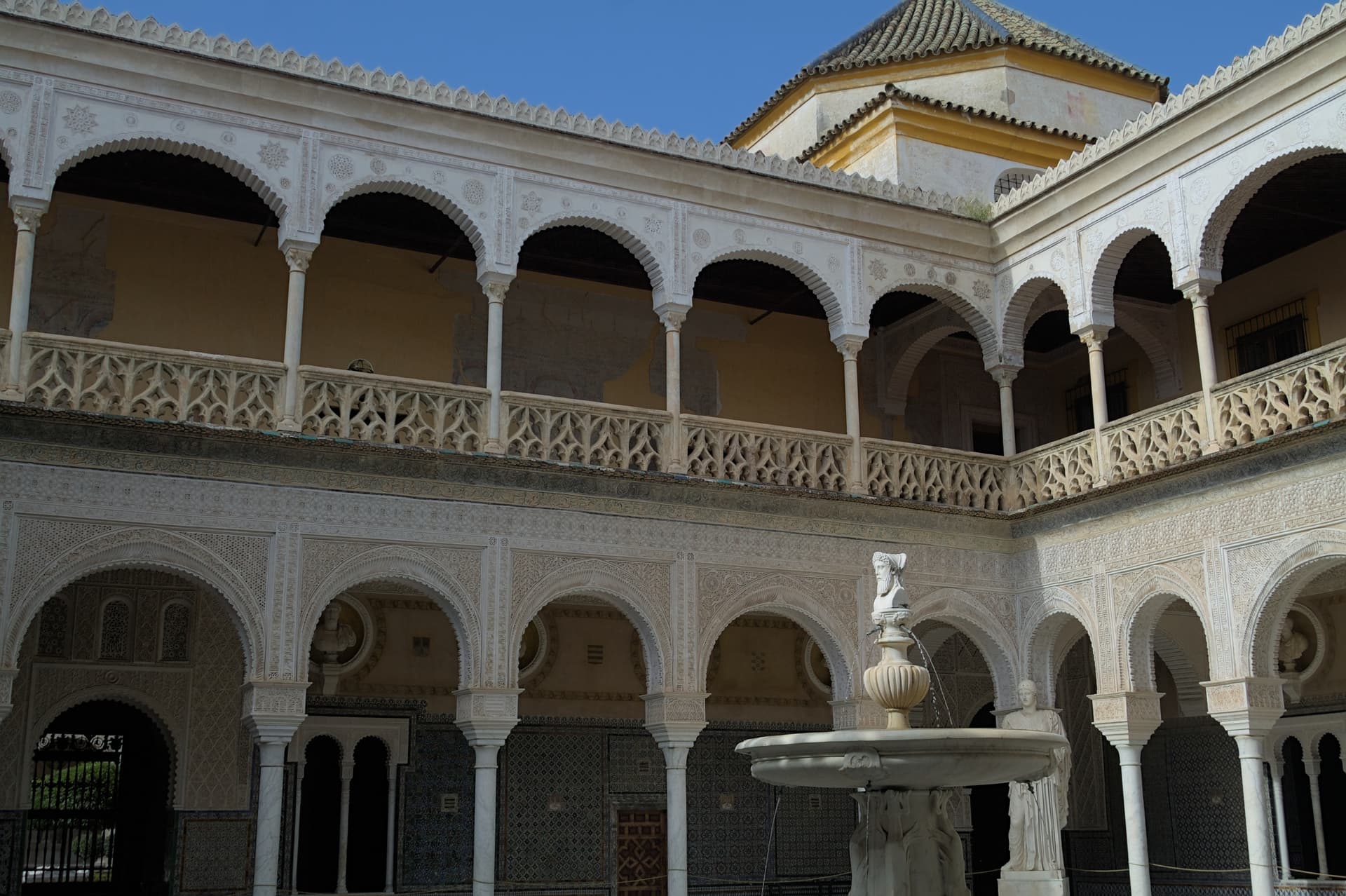
Real Alcázar: Mudéjar tiles, patios and gardens
 Photo: Unsplash
Climb the Giralda via its ramps
Cathedral of Seville: the world's largest Gothic church by floor area
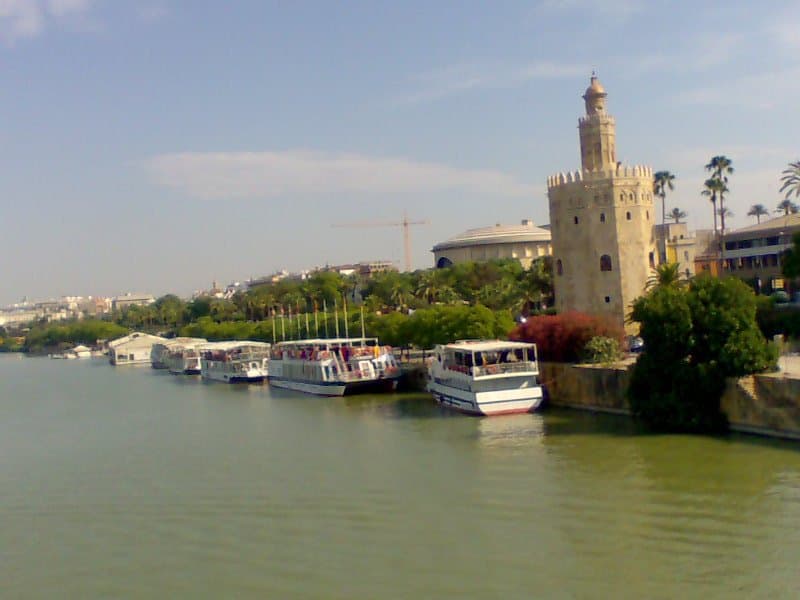 Photo: Frobles (Wikimedia, CC BY-SA 3.0)
Sail the Guadalquivir at sunset
An hour on the river, past Torre del Oro and Triana
 Photo: Schnobby (Wikimedia, CC BY-SA 3.0)
Watch live flamenco in an intimate tablao
Guitar, voice and dance up close
↗️ Worth the detour
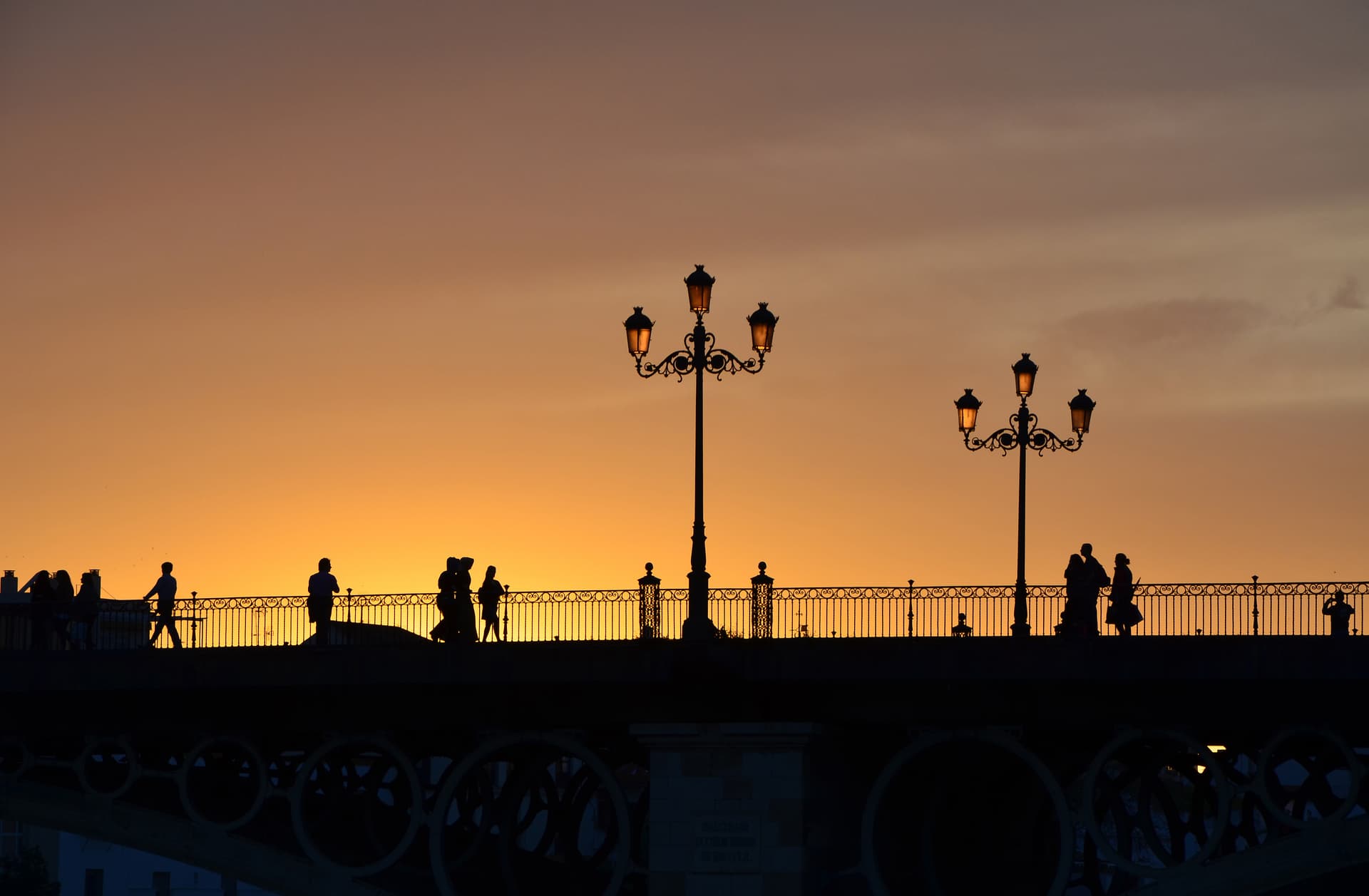
Most visitors stay on the east bank of the Guadalquivir. Cross the Puente de Isabel II into Triana, the old potters' and flamenco quarter. You'll eat among locals rather than alongside tourists, the ceramic shops are genuine, and at sunset the river behind the Torre del Oro turns orange. Start at the Mercado de Triana and work your way through the bars on the next street over.
 Mood · Seville
Eat
Where to actually eat
No tourist traps.
 Mood · Seville
Eat espinacas in the city's oldest tavern
El Rinconcillo, since 1670
 Mood · Seville
Drink sherry among the giant vats
Casa Morales, since 1850
 Mood · Seville
Taste the award-winning tapa
Bar Eslava: modern and bold
 Mood · Seville
Order the solomillo at the bar in Triana
Las Golondrinas, since 1962
 Mood · Seville
Eat among the market stalls at the bridge
Mercado de Triana, on an old castle
💡 Plan around the siesta
Plan your day around the siesta, not against it. Between roughly 14:00 and 17:00 much of the city shuts down: shops, small bars, and the heat is at its worst. Do as the locals do: morning for monuments and walking, afternoon for a long lunch or rest indoors, and only go out again from around seven in the evening onwards. Dinner rarely starts before 21:00 here.
The best tapas bars are the oldest ones: no tablecloths, just a bill the bartender chalks up on the counter.
See
What you really need to see in Seville
← swipe for more →



⚠️ Avoid this mistake
Don't book the Real Alcázar and Cathedral only at the gate. In high season there are queues of an hour or more in full sun. Book a time slot online in advance. If you want free entry, there are limited slots available (Alcázar Monday evening, Cathedral Sunday afternoon), but these go extremely fast, so get there early.
Discover
Everything on the map
Filter by what you're after.
 Mood · Seville
Cross the bridge at sunset to Triana. You'll eat among locals here, not alongside tourists.
Out and about
Best day trips
Out of the city within an hour.
 Photo: Unsplash
Córdoba
~45 min on the AVE high-speed train from Santa Justa~140 km · The Mezquita-Catedral: a mosque with a cathedral inside
Córdoba is the easiest day trip you can make: in three-quarters of an hour you're there on the high-speed train (not the regional service, depart from Seville-Santa Justa). The heart is the Mezquita-Catedral, a forest of red-and-white arches with a complete cathedral inserted into it later. You won't see anything like it anywhere else. Around it lies the old Jewish quarter with white streets and flower boxes on the walls. Go early: the Mezquita is quietest in the morning, and in summer Córdoba is even hotter than Seville. You'll be back in time for dinner.
View day trips (opens in a new tab) Photo: Unsplash
Cádiz
~1h40 on the regional train (Media Distancia) from Santa Justa~120 km · One of the oldest cities in Western Europe, wrapped by the ocean
Cádiz is the antidote to Seville's heat: an old port city wrapped almost entirely by the Atlantic Ocean, always with a breeze. The journey of around 1h40 on the regional train (no high-speed line) takes you to narrow streets, a golden cathedral dome and city beaches where you walk straight into the water. Climb the Torre Tavira for the overview and eat fresh fish at the Mercado Central. It's quieter and saltier than Seville. Take an earlier train out so you have a full day by the sea.
View day trips (opens in a new tab) Photo: Diego Delso (Wikimedia, CC BY-SA 4.0)
Itálica
~30 min on city bus M-170A from Plaza de Armas~9 km · Roman amphitheatre for 25,000 spectators + mosaic floors
Half an hour by bus and you're standing in a genuine Roman city. Itálica was the birthplace of emperors Trajan and Hadrian, and the amphitheatre, once holding 25,000 people, lets you walk right across the arena (Game of Thrones fans will recognise the dragon pit). Beautiful mosaic floors lie in place between the foundations. It's free for EU citizens, €1.50 for everyone else. Note: closed Mondays; open Tuesday to Saturday, Sunday until 15:00. Go early: there's hardly any shade.
View day trips (opens in a new tab)Practical
Everything you need to know
Weather & best time
These figures are average daily highs. Seville is the hottest major city in Europe: in July and August the thermometer regularly hits 40°C, and during the record heatwave of August 2021 it climbed to nearly 47°C. An 'average' July day of 36°C already feels intense: expect real heat between 14:00 and 18:00, so plan your day around it, with monuments in the morning and evenings in the squares. Spring and early autumn are most pleasant: April runs 22-25°C during the day; October is warmer than you'd think at 25-27°C, with orange blossoms flowering or mild early-autumn warmth, and long days. Winter is mild with the occasional short shower.
Jan
🌤️
15-18°
Apr
🌸
22-25°
Jul
🔥
35-37°
Oct
☀️
25-27°
What does a day cost?
Budget
€60, €90 /dag
A hostel bed or simple pension in Alameda or Triana, breakfast at the bar (tostada with café con leche around €3), tapas standing at the bar (€2, €4 each), the free side of the city (Torre del Oro on Mondays, the Alcázar on Monday evenings, Barrio Santa Cruz always), and everything on foot. Seville is easy on a small budget.
Mid-range
€120, €180 /dag
A boutique hotel or good B&B in Santa Cruz or Alfalfa, tickets for the Alcázar and the Cathedral, a flamenco show, lunch and dinner at genuine tapas bars with a bottle of wine, and a day trip by train to Córdoba or Cádiz.
Luxury
€250, €320+ /dag
A five-star hotel (think Hotel Alfonso XIII), a private guide through the Alcázar, fine dining, a private flamenco show or a river cruise with dinner, and taxis instead of walking. The sky is the limit; a suite in high season easily pushes this higher.
Good to know
Visa
Not needed (EU)
Payment
Card payments work almost everywhere
Plug
Type C/F · 230V
Transport
Walking · tram T1 · bus
Tap water
Safe: bring a bottle in summer
Tipping
5-10%, not compulsory
 Mood · Seville
Book the Alcázar and the Cathedral in advance. An hour queuing in the sun is not a holiday.
Sleep
Pick your neighbourhood, not the stars
By travel style: book through our partners.

Hotels in Seville
Compare hotels in Santa Cruz, Alfalfa or Triana, from boutique to budget.

Local stays
An apartment in Triana or a quiet neighbourhood like Alameda or Alfalfa.

Excursions & day trips
The Alcázar, flamenco, a river cruise and day trips to Córdoba and Cádiz, all bookable with free cancellation.
Before you go
Sorted before you set off
Worth booking ahead.
Questions
Frequently asked questions
When is the best time to visit Seville?
April, May and October are ideal: warm, long days and not the extreme heat. Avoid July and August unless you can handle temperatures above 40°C. Seville is then Europe's hottest major city, with average daily highs around 36°C and peaks above. If you do come in summer, plan around the siesta: monuments early, rest in the afternoon, and don't head out again until around seven in the evening.
How do I get from Seville airport (SVQ) to the centre?
Use the EA airport bus (Especial Aeropuerto, TUSSAM): €6 single / €8 return, 35-45 minutes, with stops at Santa Justa station, San Bernardo and Torre del Oro, among others. A taxi runs on a fixed daytime rate of around €25. From the Netherlands there's usually no direct flight to Seville, so expect a connection or a flight to Madrid (then approximately 2.5 hours on the AVE high-speed train).
Do I need to book tickets for the Alcázar and Cathedral in advance?
Yes. In high season, queues at the ticket office can be an hour or longer. Book a time slot online through the official websites. If you want free entry, there are limited slots: the Alcázar on Monday evenings (summer 18:00-19:00, winter 16:00-17:00, book online beforehand) and the Cathedral on Sunday afternoons (16:30-18:00, online). These go very quickly, so get there early.
Is Seville safe?
Yes, Seville is one of Spain's safer major cities. The main risk is pickpocketing around busy areas such as the Cathedral, Plaza de España and Santa Cruz. Normal awareness is enough: keep your bag in front of you in crowds, phone not in your back pocket. Violence against tourists is rare.
Which day trips are worth your time?
Córdoba (around 45 minutes by AVE high-speed train) for the Mezquita-Catedral, Cádiz (around 1 hour 40 minutes by regional train) for the ocean and a cool-down, and Itálica (around 30 minutes by bus M-170A) for Roman ruins. Note: Itálica is closed on Mondays. Go early in summer, as Córdoba gets even hotter than Seville then.
How do I get around the city?
Walking. The centre is compact and flat, and most highlights are within easy reach on foot. For longer distances there's a tram line (T1), buses and city bikes (Sevici); the metro barely touches the tourist centre. Tap water is safe to drink, bring a refillable bottle in summer.
Wayloha editorial · Travel sources curation
Last updated: June 2026, first publication; addresses and times fact-checked at source.
Compiled and fact-checked from official sources (royalalcazarseville.org, catedraldesevilla.es, visitasevilla.es, sevilla-airport.com, renfe.com) and travel publications. Prices, opening times and free hours change, check them shortly before your visit.
Final word: editorial
We update Seville the moment anything changes: opening hours, ticket prices and free-entry times are always first in line.
Plan your Seville tripMore in Spain
More cities in Spain

Córdoba
City trip Córdoba: the Mezquita-Catedral with 856 columns, the white lanes of the Judería and blooming patio gardens. Verified at source.
Read the guide →
Granada
City trip Granada: booking Alhambra tickets, free tapas, the Albaicín and what you really must do, fact-checked at source. No invented prices.
Read the guide →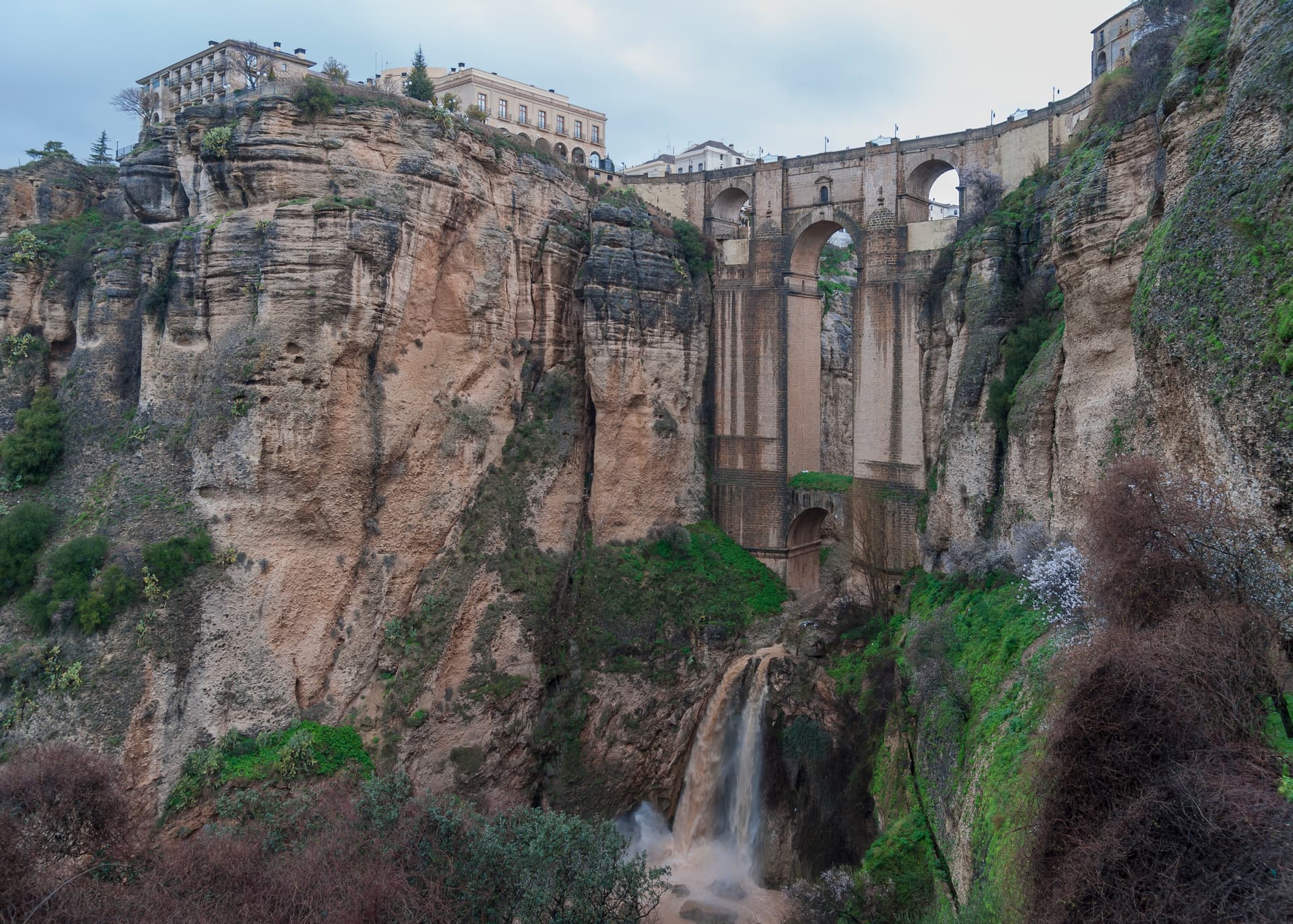
Ronda
Ronda city trip: the Puente Nuevo, the El Tajo gorge, the baños árabes and Bardal: the most dramatic city in Andalusia, verified at the source.
Read the guide →
Málaga
City break Málaga: the Alcazaba, Museo Picasso, El Pimpi and the espetos of Pedregalejo, verified at source. Costa del Sol at its most authentic.
Read the guide →
Madrid
City trip Madrid: the best museums, where you really should eat and how to avoid the tourist traps. Verified at source. No made-up prices.
Read the guide →
Valencia
Valencia city trip: authentic paella valenciana at the source, the City of Arts and Sciences and the best Albufera boat trip: verified at the source.
Read the guide →Part of Spain
New to Spain?
Read our complete Spain travel guide: regions, best time to go and practical tips before you plan your trip.